Walk into any busy grocery store on a Tuesday morning and there’s a decent chance of spotting it: a shelf label that’s crooked, knocked loose from a passing cart, or sitting in a bracket that clearly wasn’t built for it. The screen still shows the right price. It just doesn’t look like it belongs there.
That’s the part of the ESL rollout retailers tend to underestimate. The label itself solves the pricing problem. What holds it in place, protects it, and makes it look intentional on the shelf is a separate job entirely, and it’s the job ESL accessories are built to do.
Why the Accessories Around Your ESLs Matter More Than You Think
Once a store has electronic shelf labels installed, the heavy lifting is done. Prices update from a central system instead of a team walking the floor with a stack of paper tags. That part of the process is fast and reliable.
What determines whether the rollout actually looks and holds up the way it should is everything mounted around the label: the rail it sits in, the shield protecting it from cart traffic, the talker clipped onto it for a promotion. A great ESL system with the wrong hardware around it still ends up looking unfinished six months in.
Why Pricing Errors Cost More Than You Think
Nobody tracks the exact dollar amount lost to pricing errors every year. Added up over time, though, that number is usually bigger than most retailers expect.
It’s not just the direct cost of honoring the wrong price at the register, which in some provinces and states is a legal obligation, not a courtesy. There’s a ripple effect too. A customer who catches a pricing discrepancy once might let it go. A second time, and they start questioning whether the prices on the shelf can be trusted at all.
There’s operational drag as well. Every price check at checkout slows the line down. The cashier pauses, calls someone over, waits. Other customers start checking their phones. A properly mounted, secure ESL keeps the label locked in place and legible, so the price on the shelf and the price at the register stay consistent, without a label sagging, fading, or getting knocked off in the meantime.
The Customer Experience Side of Things
Accurate pricing is the obvious win, but it’s only the starting point. A well-accessorized ESL setup changes how the whole store feels to shop in.
Shelves Actually Look Put Together
Paper labels curl, fade under cooler lighting, and fall off after a few weeks, no matter how diligent the team restocking them is. It looks sloppy even when the prices are technically correct.
ESLs solve the consistency problem on their own, but pairing them with proper mounting hardware, matched data rails, and purpose-built holders is what makes a shelf edge look like it was designed on purpose rather than assembled piece by piece. Shoppers may not consciously register it, but they feel the difference.
Promotions Hit the Floor Instantly
Anyone who has tried to run a flash sale with paper signage knows the drill: printing, cutting, distributing, and hoping every department gets the right tag on the right product before customers arrive. There’s usually at least one aisle still running last week’s price.
With ESLs and the right shelf talkers in place, that scramble disappears. A shelf talker that clips or slides on in seconds means a promotion can go live storewide without anyone touching a screwdriver.
Fewer Arguments at Checkout
This one is underrated. When shelf prices and register prices match every time, price disputes at the front end mostly disappear. That means shorter lines and a checkout experience that ends cleanly instead of with a customer questioning a charge.
The last thirty seconds of a shopping trip carry an outsized influence on whether a customer comes back. A smooth, dispute-free checkout protects that impression.
Accessories Aren’t an Afterthought, They’re the Foundation
A common way ESL rollouts go sideways: a retailer invests in solid labels, gets the software configured, then mounts everything with whatever generic hardware happened to be cheapest. Months later, labels are crooked, a few have been knocked off by cart traffic, and the shelf edge looks worse than the paper tags it replaced.
It’s not a technology problem. It’s an accessories problem, and it’s avoidable. Here’s what the right accessories actually solve for:
- Keeping labels locked in place. High-traffic aisles are hard on shelf hardware. A data rail or shelf talker built for the specific ESL model keeps the label seated even when a loaded cart clips the shelf edge.
- Protecting the hardware. Most ESLs are already built to be water resistant, so they hold up fine on a standard gondola shelf. Protective shields are what matter most in high-traffic aisles, absorbing the impact when carts and totes bump into the display so the label doesn’t take the hit directly. Vinyl pouches serve a different purpose: they’re a strong option for freestanding displays, like furniture or end-cap features, where the ESL isn’t sitting inside a shelf rail at all.
- Making the brand look right. There’s a visible difference between a shelf where ESLs sit in colour-matched, custom-sized rails and one where they’re jammed into a generic universal bracket. Customers notice, even subconsciously.
- Handling non-standard displays. End caps, freestanding islands, cooler doors: not everything in a store is a standard gondola shelf. Acrylic holders and custom aisle blades allow pricing to go anywhere it’s needed, not just where a standard rail happens to fit.
Breaking Down the Key ESL Accessory Types
A quick rundown of the ESL accessory categories worth knowing before planning a rollout or cleaning up an existing one.
Data Rails and Shields
Data rails run along the shelf edge and give ESLs a secure, consistent mounting point. Manufactured to match a store’s shelf profile, they can also be colour-matched to branding. Shields sit over the labels and absorb impact from carts and totes so the ESL itself doesn’t have to.
ESL Displays and Acrylic Holders
Not every product sits on a standard shelf. An end cap, a standalone feature near the entrance, or a freestanding display all need a different mounting solution. Acrylic holders give ESLs a clean, professional way to mount on virtually any surface, often with room for an extra insert card for seasonal callouts.
Vinyl Pouches
Vinyl pouches provide an extra layer of protection for ESLs, particularly on freestanding displays and fixtures outside a standard shelf rail. A vacuum-sealed pouch keeps out dust and moisture, and a zipper option lets staff access the ESL quickly for battery swaps without breaking the seal.
Shelf Talkers for ESLs
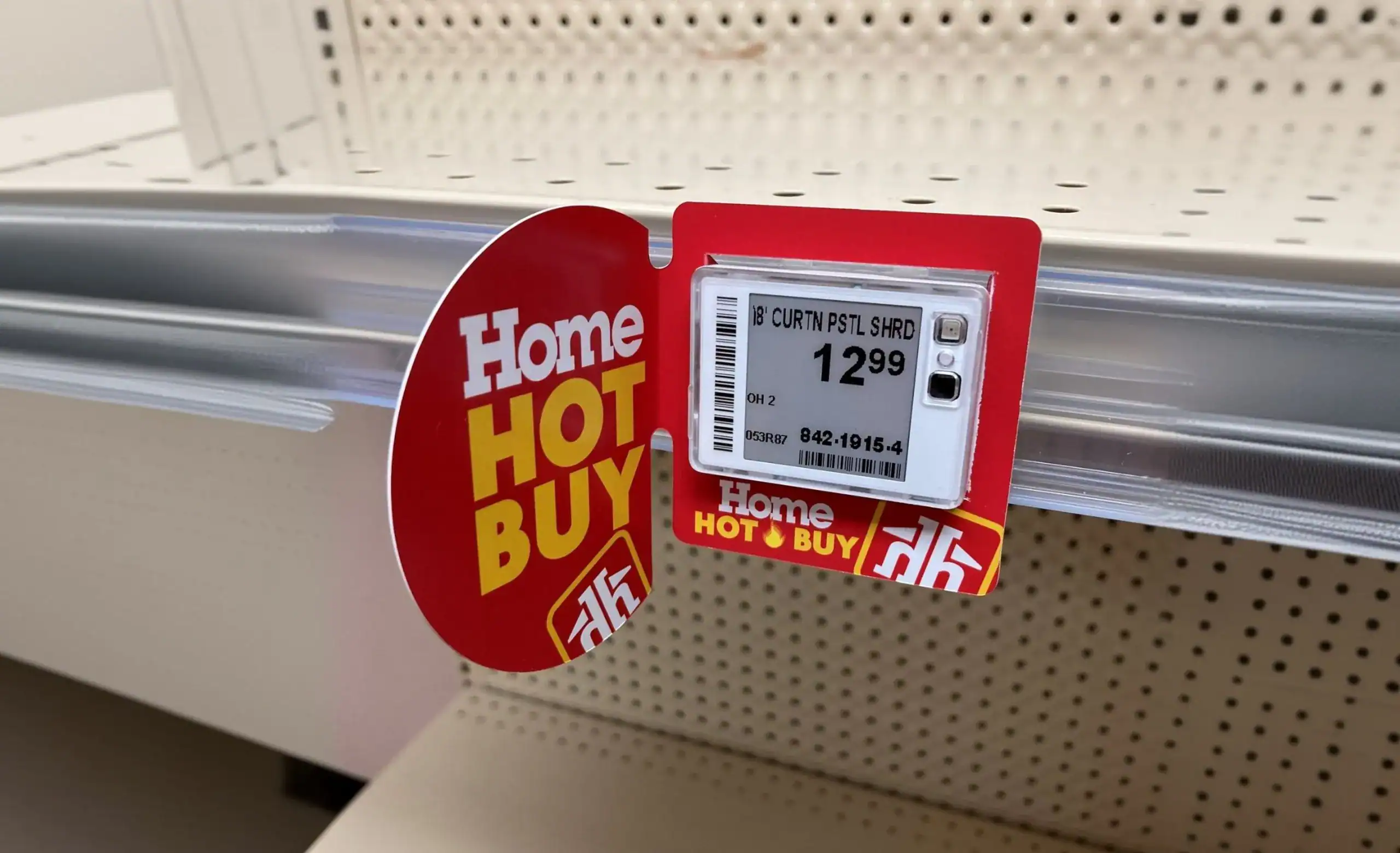
A shelf talker is a sign extension that attaches to the ESL to call out a promotion, brand message, or product highlight. What matters most in a live store is installation speed: a design that clips or slides into place in seconds, with no tools required. Pinch-and-push and hugger-style talkers are built to grip the ESL securely and swap out fast when a promotion changes.
Aisle Blades
Aisle blades extend perpendicular from the shelf so ESL pricing is readable from down the aisle, not just when a shopper is standing directly in front of the product. They’re especially useful in wide-format or warehouse-style layouts with longer sight lines, and can be cut to fit any shape, size, or ESL model.
What to Look for in an ESL Accessory Supplier
Generic ESL mounting hardware is available from plenty of vendors online, but there’s a real difference between off-the-shelf commodity parts and accessories engineered for a specific store layout and label model.
The things that matter most: in-house manufacturing, so orders aren’t waiting on a third-party factory; real customization options beyond a handful of preset sizes; and a product catalog deep enough to cover every fixture type in the store. Sourcing rails from one vendor, talkers from another, and pouches from a third tends to produce a mismatched installation that looks assembled by committee rather than designed.
A Few Practical Tips for the Transition
Swapping from paper to electronic shelf labels is a big project, but it doesn’t have to be chaotic.
Start where the pain is worst. Departments with heavy price-change volume, like grocery perishables, weekly ad items, and clearance racks, should get ESLs and matching accessories first. That’s where the time savings and error reduction show up fastest.
Order accessories with the labels, not after. A surprising number of stores order ESLs, get them delivered, and only then realize there are no rails, holders, or pouches to install them properly. Accessories belong in the project scope from day one.
Prioritize fast installation. A store doesn’t close for a remodel every time a shelf talker gets added. Whatever accessories are chosen, they need to go on quickly without disrupting the sales floor.
Buy for durability, not just price. A rail that warps after a few months or a pouch that cracks in the freezer section ends up costing more in replacements and labor than a quality product built to last for years. This is long-term infrastructure and worth treating that way.
Bringing It All Together
The case for ESL displays is well established at this point: they fix pricing errors, speed up operations, and make a store look more professional. What often gets missed is that the accessories around the labels are just as critical as the labels themselves.
A great ESL mounted with the wrong hardware is a wasted opportunity. Paired with the right data rail, the right shelf talker, and the right protective solution, a shelf edge becomes accurate, on-brand, durable, and easy to maintain. That’s where the real return shows up, not just in the technology, but in how well it’s deployed.
How Dana Industries Helps with ESL Accessories
Dana Industries builds ESL accessories in-house, including data rails, shelf talkers, acrylic holders, vinyl pouches, and aisle blades. Manufacturing everything under one roof keeps quality, cost, and lead times under control, and every piece can be customized to match a store’s branding, shelf profile, and specific ESL model.
From patented shelf talker designs built for seconds-long installation to protective shields sized for high-traffic aisles, the full lineup is built to solve the mounting and protection side of an ESL rollout, not just supply generic parts. Full details are available on the ESL Accessories page, along with design and manufacturing services for stores with non-standard fixtures.